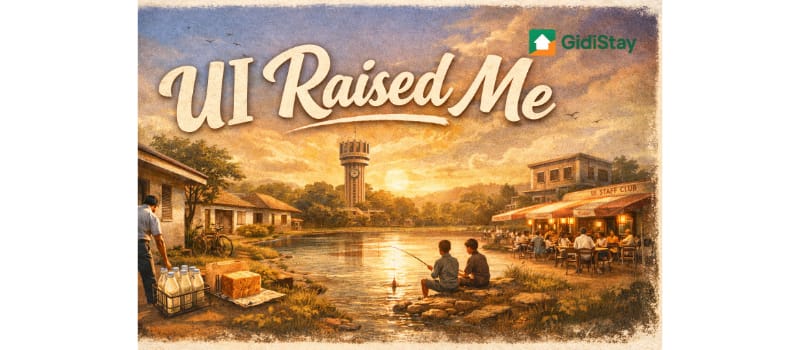
✨ UI: The Childhood We Didn’t Know Was Gold
There was a time in the University of Ibadan when milk arrived at our doorsteps. Let that sink in.
Milk. Delivered. To your door.
And bread too.
When I mention this now, people pause. They look at me the way you look at someone describing a dream that sounds too perfect to be true. “How could that have happened?” they ask. And honestly, I ask myself the same question—not because it didn’t happen, but because of how far away it now feels.
We had constant water. Steady light. And a generator house in Abadina that felt like the heartbeat of the university—alive, humming, dependable.
That generator house wasn’t just a building. It was reassurance. It was structure. It was the quiet confidence that someone, somewhere, had thought things through.
Today, I hear it’s mostly just a shell. A shadow. A building that exists more in memory than in function. And I can’t help but wonder:
What happened to the people who worked there? The engineers. The operators. The custodians of reliability.
Did they retire quietly? Were they reassigned? Forgotten? Or did the system simply… move on without them?
🔍 How Do Good Systems Die?
How do things that once worked stop working, while everyone looks the other way?
- Was it neglect?
- Was it politics?
- Was it the slow erosion that comes when maintenance is no longer glamorous, and excellence is no longer demanded?
Or is it something deeper—when a society slowly stops believing it deserves good things?
🍗 Don’t Even Get Me Started on UI Staff Club
Ah. The Staff Club.
If you know, you know.
That chicken pie. That smell. That first bite.
Till today—today—that chicken pie remains my gold standard. I have searched. I have tried. I have hoped. But I have never truly found anything that fully recreates that taste. Not just the flavor—the memory baked into it. The warmth. The certainty that some things were done with pride.
Was it the recipe? The ovens? Or was it the spirit of a place that cared?
🏞️ Awba Dam and the Innocence of Time
And then there’s Awba Dam.
Fishing days. Carefree laughter. Water that wasn’t just water—it was adventure, freedom, childhood wrapped in sunlight.
We didn’t know we were building lifelong memories. We thought we were just passing time.
Isn’t that how it always is?
🌟 UI Wasn’t Just a Place — It Was a Feeling
UI wasn’t just an institution. It was an ecosystem. A promise. A glimpse of what Nigeria could be when things are planned, maintained, and respected.
And here’s the twist that still makes me smile:
At the end of the day… I didn’t even attend UI. 😄
Yet UI raised me. Formed me. Left fingerprints on who I became.
That’s the power of a well-run system—it touches even those who pass through it briefly.
❓ The Question We Must Ask Ourselves
What are we building today that our children will remember with this kind of ache?
What systems are quietly failing right now while we scroll past them, distracted, resigned?
And more importantly:
Do we still believe we deserve milk at our doorstep, steady light, running water, and chicken pies made with pride?
UI is not just a memory. It’s a mirror.
And maybe—just maybe—it’s still reminding us of who we once were… and who we can choose to be again.
🌍 The Twist: This Is Bigger Than You and Me
Before you scroll away, pause for a second.
If University of Ibadan raised you—even if you never formally attended it—then this story is also your story.
You opened your tap and water actually ran. You slept under steady light without thinking twice. You tasted that Staff Club chicken pie and quietly decided, “Yes… this is how things should be.”
And maybe, like me, you now carry that memory as a quiet benchmark for life.
So here’s the twist 👇🏾
Share this with one UI-raised individual like you and I. Just one.
Share it with someone who will read it and say:
“Ah… you remember too?”
Because these memories matter. They remind us that excellence once existed here—not as an exception, but as a norm.
And if it existed once, it can exist again.
UI didn’t just raise academics. It raised standards. It raised expectations. It raised us.