 **Buy something I needed and leave.**
But before I knew it, I had become part of a carefully designed customer journey.
And as a business owner, I couldn't stop thinking about it.
It started with one simple question:
**“Would you like a chance to win a $2,000 shopping spree?”**
Well, now you have my attention.
## The $2,000 Hook
To participate, I was asked for some basic information—my name, phone number and address.
Then something interesting happened.
The representative got someone else on the phone and introduced me as someone interested in participating in the promotion.
The conversation quickly moved beyond the giveaway.
I was asked:
**“Are you a homeowner?”**
Then:
**“What type of water treatment do you currently use in your home?”**
And eventually:
**“Would it be okay for someone to come to your house and test your water?”**
We started discussing my availability.
And just like that…
I had an appointment.
Think about what just happened.
I walked into a home-improvement store for an entirely different reason.
Nobody standing outside screamed:
**“BUY A WATER TREATMENT SYSTEM!”**
Instead, the process was:
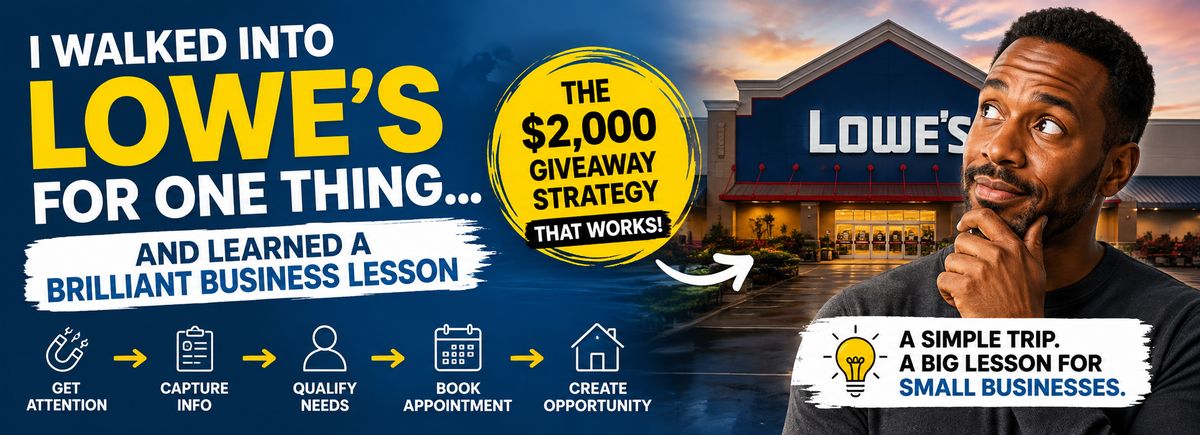
**Attention → Information → Qualification → Conversation → Appointment → Sales Opportunity**
That is intentionality.
## The Water Test Isn't Really the End Goal
Someone is going to come to my house and test my water.
Maybe everything will be perfect.
Maybe they'll identify something that could be improved.
But clearly, the water test creates an opportunity to demonstrate a problem and potentially present a solution.
And that made me think about something many small businesses get wrong.
## Your Customers Probably Don't Know Everything You Do
Business owners sometimes assume:
*"My customers know what we offer."*
They probably don't.
You might have five services.
Your customer may know **one**.
You might solve three different problems for them.
They may associate your company with only **one problem**.
And here's the lesson I took away from my experience:
> **If you don't intentionally introduce customers to the other things your business can do, they may never know they need them.**
Having another service buried somewhere on your website isn't enough.
You have to create pathways that help customers discover it.
## Stop Waiting for Customers to Ask
Imagine someone comes to you to buy a house.
That tells you something about them.
They're not simply a "real estate customer."
They're a person with other potential needs.
Likewise, someone planning an office event isn't simply looking for tickets.
They may need:
* Guest registration
* QR ticketing and check-in
* Team-bonding activities
* Trivia and interactive games
* Networking experiences
* Event planners
* Guest management
* Post-event engagement
But here's the problem.
**They may never ask you about any of those things.**
Why?
Because they don't know you offer them.
That's where business intentionality comes in.
## The Question Every Small Business Should Ask
Instead of constantly asking:
**“How do we find more customers?”**
Try asking:
**“How can we create more value for the customers who already know us?”**
That's a very different question.
If someone trusts your company enough to use one service, you have already crossed one of the biggest barriers in business:
**Trust.**
Now your job is not to bombard them with everything else you sell.
Your job is to intelligently introduce the **next relevant solution**.
## And Yes…I'm Borrowing the Lowe’s Idea for GidiStay
The experience made me look at GidiStay differently.
Many people know GidiStay through **real estate**.
That's an important part of what we do.
But it's not everything we do.
GidiStay also helps businesses, organizations and individuals create better event experiences.
Through **GidiStay Events & Ticketing**, businesses can explore solutions for guest management, ticketing, interactive event experiences and corporate events.
And one area I'm particularly excited about is **team bonding**.
Instead of another office event where everyone eats, talks to the same three people they already know and goes home, companies can build interaction into the experience.
Trivia.
Games.
Challenges.
Networking.
Friendly competition.
Experiences designed to get employees talking, laughing and working together.
Someone who originally discovered GidiStay because of real estate may never know any of this exists.
**Unless we intentionally tell them.**
## That's the Lowe’s Business Model I'm Taking Home
I walked into Lowe’s looking for one thing.
They introduced me to something else.
Not randomly.
They created a journey.
They got my attention.
They learned something about me.
They identified whether I might have a need.
And they offered the next step.
That's something businesses of every size can learn from.
You don't necessarily need a massive advertising budget.
Sometimes you simply need to become more intentional about the customers already walking through your door.
Ask yourself:
**What else could we genuinely help this customer with?**
Then build a natural pathway that allows them to discover it.
Because your next sale may not come from finding another customer.
**It may come from helping an existing customer discover something they never knew you could do.**
### What Else Can GidiStay Do for You?
If you know GidiStay for real estate, take another look.
And if your company is planning an office event, corporate function or team-bonding experience, discover what GidiStay Events & Ticketing can bring to it.
**Don't just organize another event. Create an experience your team will actually remember.**
Visit **GidiStay.com** and discover what else GidiStay can do for you.
Maybe I learned something from Lowe’s after all.
**Buy something I needed and leave.**
But before I knew it, I had become part of a carefully designed customer journey.
And as a business owner, I couldn't stop thinking about it.
It started with one simple question:
**“Would you like a chance to win a $2,000 shopping spree?”**
Well, now you have my attention.
## The $2,000 Hook
To participate, I was asked for some basic information—my name, phone number and address.
Then something interesting happened.
The representative got someone else on the phone and introduced me as someone interested in participating in the promotion.
The conversation quickly moved beyond the giveaway.
I was asked:
**“Are you a homeowner?”**
Then:
**“What type of water treatment do you currently use in your home?”**
And eventually:
**“Would it be okay for someone to come to your house and test your water?”**
We started discussing my availability.
And just like that…
I had an appointment.
Think about what just happened.
I walked into a home-improvement store for an entirely different reason.
Nobody standing outside screamed:
**“BUY A WATER TREATMENT SYSTEM!”**
Instead, the process was:
**Attention → Information → Qualification → Conversation → Appointment → Sales Opportunity**
That is intentionality.
## The Water Test Isn't Really the End Goal
Someone is going to come to my house and test my water.
Maybe everything will be perfect.
Maybe they'll identify something that could be improved.
But clearly, the water test creates an opportunity to demonstrate a problem and potentially present a solution.
And that made me think about something many small businesses get wrong.
## Your Customers Probably Don't Know Everything You Do
Business owners sometimes assume:
*"My customers know what we offer."*
They probably don't.
You might have five services.
Your customer may know **one**.
You might solve three different problems for them.
They may associate your company with only **one problem**.
And here's the lesson I took away from my experience:
> **If you don't intentionally introduce customers to the other things your business can do, they may never know they need them.**
Having another service buried somewhere on your website isn't enough.
You have to create pathways that help customers discover it.
## Stop Waiting for Customers to Ask
Imagine someone comes to you to buy a house.
That tells you something about them.
They're not simply a "real estate customer."
They're a person with other potential needs.
Likewise, someone planning an office event isn't simply looking for tickets.
They may need:
* Guest registration
* QR ticketing and check-in
* Team-bonding activities
* Trivia and interactive games
* Networking experiences
* Event planners
* Guest management
* Post-event engagement
But here's the problem.
**They may never ask you about any of those things.**
Why?
Because they don't know you offer them.
That's where business intentionality comes in.
## The Question Every Small Business Should Ask
Instead of constantly asking:
**“How do we find more customers?”**
Try asking:
**“How can we create more value for the customers who already know us?”**
That's a very different question.
If someone trusts your company enough to use one service, you have already crossed one of the biggest barriers in business:
**Trust.**
Now your job is not to bombard them with everything else you sell.
Your job is to intelligently introduce the **next relevant solution**.
## And Yes…I'm Borrowing the Lowe’s Idea for GidiStay
The experience made me look at GidiStay differently.
Many people know GidiStay through **real estate**.
That's an important part of what we do.
But it's not everything we do.
GidiStay also helps businesses, organizations and individuals create better event experiences.
Through **GidiStay Events & Ticketing**, businesses can explore solutions for guest management, ticketing, interactive event experiences and corporate events.
And one area I'm particularly excited about is **team bonding**.
Instead of another office event where everyone eats, talks to the same three people they already know and goes home, companies can build interaction into the experience.
Trivia.
Games.
Challenges.
Networking.
Friendly competition.
Experiences designed to get employees talking, laughing and working together.
Someone who originally discovered GidiStay because of real estate may never know any of this exists.
**Unless we intentionally tell them.**
## That's the Lowe’s Business Model I'm Taking Home
I walked into Lowe’s looking for one thing.
They introduced me to something else.
Not randomly.
They created a journey.
They got my attention.
They learned something about me.
They identified whether I might have a need.
And they offered the next step.
That's something businesses of every size can learn from.
You don't necessarily need a massive advertising budget.
Sometimes you simply need to become more intentional about the customers already walking through your door.
Ask yourself:
**What else could we genuinely help this customer with?**
Then build a natural pathway that allows them to discover it.
Because your next sale may not come from finding another customer.
**It may come from helping an existing customer discover something they never knew you could do.**
### What Else Can GidiStay Do for You?
If you know GidiStay for real estate, take another look.
And if your company is planning an office event, corporate function or team-bonding experience, discover what GidiStay Events & Ticketing can bring to it.
**Don't just organize another event. Create an experience your team will actually remember.**
Visit **GidiStay.com** and discover what else GidiStay can do for you.
Maybe I learned something from Lowe’s after all.
The $2,000 Lowe’s Giveaway Taught Me Something Every Small Business Owner Should Know
Published:
Reading time: 5 min read
A simple trip to Lowe’s revealed a powerful lesson about lead generation, cross-selling and business intentionality that every small business owner can use.
# I Walked Into Lowe’s for One Thing—and Learned a Brilliant Business Lesson
I walked into Lowe’s today to do what millions of people do every day:
**Buy something I needed and leave.**
But before I knew it, I had become part of a carefully designed customer journey.
And as a business owner, I couldn't stop thinking about it.
It started with one simple question:
**“Would you like a chance to win a $2,000 shopping spree?”**
Well, now you have my attention.
## The $2,000 Hook
To participate, I was asked for some basic information—my name, phone number and address.
Then something interesting happened.
The representative got someone else on the phone and introduced me as someone interested in participating in the promotion.
The conversation quickly moved beyond the giveaway.
I was asked:
**“Are you a homeowner?”**
Then:
**“What type of water treatment do you currently use in your home?”**
And eventually:
**“Would it be okay for someone to come to your house and test your water?”**
We started discussing my availability.
And just like that…
I had an appointment.
Think about what just happened.
I walked into a home-improvement store for an entirely different reason.
Nobody standing outside screamed:
**“BUY A WATER TREATMENT SYSTEM!”**
Instead, the process was:
**Attention → Information → Qualification → Conversation → Appointment → Sales Opportunity**
That is intentionality.
## The Water Test Isn't Really the End Goal
Someone is going to come to my house and test my water.
Maybe everything will be perfect.
Maybe they'll identify something that could be improved.
But clearly, the water test creates an opportunity to demonstrate a problem and potentially present a solution.
And that made me think about something many small businesses get wrong.
## Your Customers Probably Don't Know Everything You Do
Business owners sometimes assume:
*"My customers know what we offer."*
They probably don't.
You might have five services.
Your customer may know **one**.
You might solve three different problems for them.
They may associate your company with only **one problem**.
And here's the lesson I took away from my experience:
> **If you don't intentionally introduce customers to the other things your business can do, they may never know they need them.**
Having another service buried somewhere on your website isn't enough.
You have to create pathways that help customers discover it.
## Stop Waiting for Customers to Ask
Imagine someone comes to you to buy a house.
That tells you something about them.
They're not simply a "real estate customer."
They're a person with other potential needs.
Likewise, someone planning an office event isn't simply looking for tickets.
They may need:
* Guest registration
* QR ticketing and check-in
* Team-bonding activities
* Trivia and interactive games
* Networking experiences
* Event planners
* Guest management
* Post-event engagement
But here's the problem.
**They may never ask you about any of those things.**
Why?
Because they don't know you offer them.
That's where business intentionality comes in.
## The Question Every Small Business Should Ask
Instead of constantly asking:
**“How do we find more customers?”**
Try asking:
**“How can we create more value for the customers who already know us?”**
That's a very different question.
If someone trusts your company enough to use one service, you have already crossed one of the biggest barriers in business:
**Trust.**
Now your job is not to bombard them with everything else you sell.
Your job is to intelligently introduce the **next relevant solution**.
## And Yes…I'm Borrowing the Lowe’s Idea for GidiStay
The experience made me look at GidiStay differently.
Many people know GidiStay through **real estate**.
That's an important part of what we do.
But it's not everything we do.
GidiStay also helps businesses, organizations and individuals create better event experiences.
Through **GidiStay Events & Ticketing**, businesses can explore solutions for guest management, ticketing, interactive event experiences and corporate events.
And one area I'm particularly excited about is **team bonding**.
Instead of another office event where everyone eats, talks to the same three people they already know and goes home, companies can build interaction into the experience.
Trivia.
Games.
Challenges.
Networking.
Friendly competition.
Experiences designed to get employees talking, laughing and working together.
Someone who originally discovered GidiStay because of real estate may never know any of this exists.
**Unless we intentionally tell them.**
## That's the Lowe’s Business Model I'm Taking Home
I walked into Lowe’s looking for one thing.
They introduced me to something else.
Not randomly.
They created a journey.
They got my attention.
They learned something about me.
They identified whether I might have a need.
And they offered the next step.
That's something businesses of every size can learn from.
You don't necessarily need a massive advertising budget.
Sometimes you simply need to become more intentional about the customers already walking through your door.
Ask yourself:
**What else could we genuinely help this customer with?**
Then build a natural pathway that allows them to discover it.
Because your next sale may not come from finding another customer.
**It may come from helping an existing customer discover something they never knew you could do.**
### What Else Can GidiStay Do for You?
If you know GidiStay for real estate, take another look.
And if your company is planning an office event, corporate function or team-bonding experience, discover what GidiStay Events & Ticketing can bring to it.
**Don't just organize another event. Create an experience your team will actually remember.**
Visit **GidiStay.com** and discover what else GidiStay can do for you.
Maybe I learned something from Lowe’s after all.
**Buy something I needed and leave.**
But before I knew it, I had become part of a carefully designed customer journey.
And as a business owner, I couldn't stop thinking about it.
It started with one simple question:
**“Would you like a chance to win a $2,000 shopping spree?”**
Well, now you have my attention.
## The $2,000 Hook
To participate, I was asked for some basic information—my name, phone number and address.
Then something interesting happened.
The representative got someone else on the phone and introduced me as someone interested in participating in the promotion.
The conversation quickly moved beyond the giveaway.
I was asked:
**“Are you a homeowner?”**
Then:
**“What type of water treatment do you currently use in your home?”**
And eventually:
**“Would it be okay for someone to come to your house and test your water?”**
We started discussing my availability.
And just like that…
I had an appointment.
Think about what just happened.
I walked into a home-improvement store for an entirely different reason.
Nobody standing outside screamed:
**“BUY A WATER TREATMENT SYSTEM!”**
Instead, the process was:
**Attention → Information → Qualification → Conversation → Appointment → Sales Opportunity**
That is intentionality.
## The Water Test Isn't Really the End Goal
Someone is going to come to my house and test my water.
Maybe everything will be perfect.
Maybe they'll identify something that could be improved.
But clearly, the water test creates an opportunity to demonstrate a problem and potentially present a solution.
And that made me think about something many small businesses get wrong.
## Your Customers Probably Don't Know Everything You Do
Business owners sometimes assume:
*"My customers know what we offer."*
They probably don't.
You might have five services.
Your customer may know **one**.
You might solve three different problems for them.
They may associate your company with only **one problem**.
And here's the lesson I took away from my experience:
> **If you don't intentionally introduce customers to the other things your business can do, they may never know they need them.**
Having another service buried somewhere on your website isn't enough.
You have to create pathways that help customers discover it.
## Stop Waiting for Customers to Ask
Imagine someone comes to you to buy a house.
That tells you something about them.
They're not simply a "real estate customer."
They're a person with other potential needs.
Likewise, someone planning an office event isn't simply looking for tickets.
They may need:
* Guest registration
* QR ticketing and check-in
* Team-bonding activities
* Trivia and interactive games
* Networking experiences
* Event planners
* Guest management
* Post-event engagement
But here's the problem.
**They may never ask you about any of those things.**
Why?
Because they don't know you offer them.
That's where business intentionality comes in.
## The Question Every Small Business Should Ask
Instead of constantly asking:
**“How do we find more customers?”**
Try asking:
**“How can we create more value for the customers who already know us?”**
That's a very different question.
If someone trusts your company enough to use one service, you have already crossed one of the biggest barriers in business:
**Trust.**
Now your job is not to bombard them with everything else you sell.
Your job is to intelligently introduce the **next relevant solution**.
## And Yes…I'm Borrowing the Lowe’s Idea for GidiStay
The experience made me look at GidiStay differently.
Many people know GidiStay through **real estate**.
That's an important part of what we do.
But it's not everything we do.
GidiStay also helps businesses, organizations and individuals create better event experiences.
Through **GidiStay Events & Ticketing**, businesses can explore solutions for guest management, ticketing, interactive event experiences and corporate events.
And one area I'm particularly excited about is **team bonding**.
Instead of another office event where everyone eats, talks to the same three people they already know and goes home, companies can build interaction into the experience.
Trivia.
Games.
Challenges.
Networking.
Friendly competition.
Experiences designed to get employees talking, laughing and working together.
Someone who originally discovered GidiStay because of real estate may never know any of this exists.
**Unless we intentionally tell them.**
## That's the Lowe’s Business Model I'm Taking Home
I walked into Lowe’s looking for one thing.
They introduced me to something else.
Not randomly.
They created a journey.
They got my attention.
They learned something about me.
They identified whether I might have a need.
And they offered the next step.
That's something businesses of every size can learn from.
You don't necessarily need a massive advertising budget.
Sometimes you simply need to become more intentional about the customers already walking through your door.
Ask yourself:
**What else could we genuinely help this customer with?**
Then build a natural pathway that allows them to discover it.
Because your next sale may not come from finding another customer.
**It may come from helping an existing customer discover something they never knew you could do.**
### What Else Can GidiStay Do for You?
If you know GidiStay for real estate, take another look.
And if your company is planning an office event, corporate function or team-bonding experience, discover what GidiStay Events & Ticketing can bring to it.
**Don't just organize another event. Create an experience your team will actually remember.**
Visit **GidiStay.com** and discover what else GidiStay can do for you.
Maybe I learned something from Lowe’s after all.